
VNC Automotive
Date:
2nd November 2026
CarPlay Ultra Q&A: What it means for OEMs and how VNC Automotive can help
Apple’s introduction to CarPlay Ultra marks the most significant evolution of the CarPlay experience since its original launch. Moving beyond simple smartphone projection, CarPlay Ultra brings deeper vehicle integration, expanded display support, and new opportunities for OEMs to create a more connected in-vehicle experience.
In this Q&A, we talk with Peter Galek, Director of Product Engineering at VNC Automotive, and explore what CarPlay Ultra is, how it differs from standard CarPlay, and how VNC Automotive is supporting customers as the technology evolves.
What is CarPlay Ultra?
CarPlay Ultra is the next generation of Apple CarPlay, designed to integrate far more deeply with a vehicle than standard CarPlay.
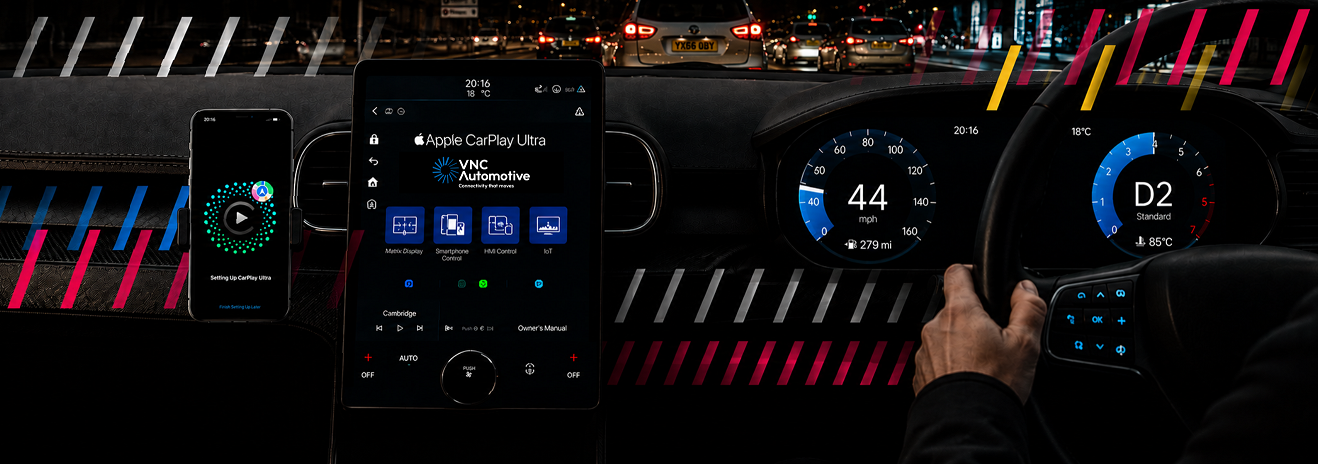
Unlike traditional CarPlay, which primarily operates on the centre infotainment display, CarPlay Ultra can extend across multiple vehicle screens, including the digital instrument cluster, secondary displays, and head-up displays. It also introduces integrated vehicle controls within the CarPlay experience, allowing drivers to interact with functions such as climate control, seat settings, and drive modes without leaving the Apple interface.
CarPlay Ultra builds on the existing CarPlay experience and can be viewed as a superset of traditional CarPlay functionality, adding deeper vehicle integration while retaining the familiar Apple ecosystem that drivers already know.
When was CarPlay Ultra announced?
Apple officially announced CarPlay Ultra on 15 May 2025, introducing the name and revealing Aston Martin as the first launch partner.
However, the underlying concept predates the announcement. Apple first unveiled its vision for a next-generation CarPlay experience at WWDC 2022, showcasing a deeper, multi-screen integration that would extend beyond the centre infotainment display. At that stage, the technology had not yet been named CarPlay Ultra. Needless to say, we had been keeping a close eye on these early developments!
The May 2025 announcement marked the transition from concept to reality, with the first production vehicles bringing the enhanced experience to market.
What vehicle manufacturers are adopting CarPlay Ultra?
Early adopters include:
- Aston Martin
- Hyundai
- Genesis
- Kia
- Porsche
Aston Martin became the first manufacturer to launch vehicles featuring CarPlay Ultra in selected markets.
As with any emerging automotive technology, OEM roadmaps continue to evolve. Several manufacturers are adjusting their development roadmaps and we expect to see more implementations announced in the near-future.
How is CarPlay Ultra different from standard CarPlay?
CarPlay is primarily a smartphone projection solution. It allows drivers to access apps such as Maps, Music, Phone, and Messages through the centre display but remains largely separate from core vehicle systems. CarPlay Ultra significantly expands this capability.
Key differences include:
Deep Vehicle Integration
CarPlay Ultra enables vehicle controls directly within the CarPlay user interface, including:
- Climate settings
- Seat heating and ventilation
- Drive mode selection
- Vehicle status information
This reduces the need for drivers to switch between CarPlay and the vehicle’s native interface.
Multi-Screen Experience
CarPlay Ultra supports content across multiple displays throughout the cockpit, creating a more unified user experience.
Customisable Instrument Cluster
OEMs can integrate Apple-designed visual experiences into the driver’s digital instrument cluster while maintaining brand identity and vehicle-specific information.
Richer Widget Support
Drivers can access iPhone-powered widgets such as:
- Weather
- Calendar
- Reminders
- Media controls
- Navigation information
across different display areas within the vehicle.
Wireless Operation
Current implementations of CarPlay Ultra are wireless-only. Unlike standard CarPlay, no wired CarPlay Ultra deployments have been announced to date.
Which vehicle screens can CarPlay Ultra support?
CarPlay Ultra supports a broad range of displays across modern vehicle architectures.
Digital Instrument Cluster
The display directly in front of the driver, presenting information such as Speedometer, Tachometer, Fuel or battery information, Vehicle temperature data, Media information, and Turn-by-turn navigation.
Centre Infotainment Display
The primary touchscreen continues to host, Apple applications, Navigation, Media and communications, and 3rd party Apps, but now blends in new functionality typically found only in the native display.
Additional Driver Displays
For vehicles equipped with multiple driver-facing displays, CarPlay Ultra can support, Lower climate control displays, Secondary driver information screens, Auxiliary cockpit displays
Passenger Displays
Where supported by the OEM, passenger screens offer a unique place for additional content such as: Entertainment content, Tailored OEM applications, Commercial experiences, Rear-seat content
Head-Up Displays (HUD)
CarPlay Ultra can also provide content for HUD systems, including, Speed information, Efficiency metrics. Driving assistance information, Navigation guidance, Vehicle status indicators
Is CarPlay Ultra similar to Android Automotive OS?
No, not really. Although both technologies deliver rich in-vehicle experiences, they have fundamentally different architectures.
Android Automotive OS (AAOS) is a complete operating system that runs directly on the vehicle head unit. Applications and services operate on the vehicle itself and do not require a connected smartphone.
CarPlay Ultra, on the other hand, remains dependent on an iPhone. The vehicle continues to run its own underlying operating system, whether Linux, QNX, Android, or another platform. CarPlay Ultra works alongside that host system rather than replacing it.
This means that while CarPlay Ultra creates a much more integrated experience than standard CarPlay, it is not a vehicle operating system in the same sense as AAOS.
Can VNC Automotive support CarPlay Ultra projects?
Yes. VNC Automotive’s engineering teams were delighted to report after their early review of the technology that integration into our Cobalt Link solution was a natural fit. Cobalt Link is offered typically as an SDK with optional modules, supporting multiple phone projection technologies, including CarPlay and Android Auto, and our proprietary Cobalt Link+ technology.
CarPlay Ultra builds upon many of the same foundations as the existing CarPlay stack, allowing us to leverage our extensive expertise and existing platform capabilities.
One area that remains under active discussion across the industry is Apple’s certification and approval process for CarPlay Ultra programmes. Close collaboration between OEMs, Apple, and suppliers will be essential as projects progress.
Is Apple still evolving CarPlay Ultra feature set?
Yes. Certain aspects of the platform continue to be refined as Apple works closely with project teams during active vehicle programmes. As with many next-generation automotive technologies, requirements, capabilities, and implementation approaches continue to mature as production deployments expand.
What experience does VNC Automotive have with CarPlay?
VNC Automotive has been delivering CarPlay solutions for more than a decade. We are a current MFi member and a fully registered Apple technology supplier.
Our first CarPlay integrations began in the early to mid-2010s, and our technology has since been deployed across production vehicle programmes worldwide. Today, we are proud to have certified CarPlay integrations operating in tens of millions of vehicles, providing OEMs with proven expertise across development, integration, optimisation, and certification.
What information is needed to start a CarPlay Ultra project?
To begin discussions, we typically ask customers to provide:
- Target platform and operating system
- Intended vehicle model or programme
- Planned development timelines
- Target display configuration:
- Centre display
- Instrument cluster
- Passenger display
- Additional displays
- Existing UI concepts, wireframes, or mock-ups
- Status of engagement with Apple
Where dialogue with Apple has not yet commenced, VNC Automotive can help facilitate those conversations. It is worth noting that modern, mid-to-high-end hardware platforms are generally favoured to deliver the polished, responsive experience expected by users and demanded by Apple’s certification standards.
VNC Automotive’s technology stack is highly optimised and fit-for-purpose to achieve optimal results, having been through multiple certification programmes, and deployed widely in the market.
What additional services does VNC Automotive offer?
Support and Maintenance Service
Our Support and Maintenance Service helps customers address:
- Critical functional defects
- Device compatibility issues
- Security vulnerabilities
- Production support requirements
This ensures SDK deployments remain reliable throughout the vehicle lifecycle.
Certification Support Service
For customers seeking additional assistance, we offer optional certification support that includes:
Thanks to the maturity of our SDK and extensive internal test coverage, SDK-related issues are rarely the critical path for certification programmes. Customers particularly value our ability to investigate complex platform-level issues outside of our own stack quickly and efficiently.
We can also help with matters such as Project plan reviews, Documentation and UX assessment, the testing process, Test lab selection, Advanced debugging support, Exemption request assistance where required
Integration Support Service
For programmes with demanding schedules or limited engineering resources, VNC Automotive can provide dedicated integration support, including:
- Platform-specific patch development
- Hardware optimisation
- Performance tuning
- Security optimisation
- Audio integration support
- Echo cancellation optimisation
- Noise reduction implementation
- Targeted sample code
- Expedited support response times
How has VNC Automotive’s experience with CarPlay Ultra been so far?
Our experience with CarPlay Ultra has been extremely positive. As a company with deep expertise in CarPlay integration, we found that our engineering teams were able to get up to speed with the new architecture quickly, and begin evaluating the technology in a practical environment.
Before long, our teams had demonstration implementations running across multiple platforms, including Linux, Android, and Android Automotive OS (AAOS). This early work has given us valuable insight into the opportunities and considerations associated with bringing CarPlay Ultra to production vehicle programmes.
One of the most interesting aspects of the platform has been seeing some of Apple’s new architectural approaches in action. A notable example is the Display Plugin framework, which supports the “punch-through” UI concept, allowing extremely efficient rendering of content on the host system (using e.g. Lua) while remaining coordinated through the CarPlay Ultra connection with the iPhone.
What does CarPlay Ultra mean for the future?
CarPlay Ultra represents an important shift toward more connected and personalised in-vehicle experiences. As the technology develops and adoption grows, OEMs will increasingly need solutions that bridge smartphone ecosystems, vehicle platforms, multiple displays, and certification requirements.
For VNC Automotive, this evolution aligns perfectly with our expertise. With deep experience in certified CarPlay deployments and a clear path to supporting CarPlay Ultra, we look forward to helping OEMs bring next-generation cockpit experiences to market.
2nd November 2026